
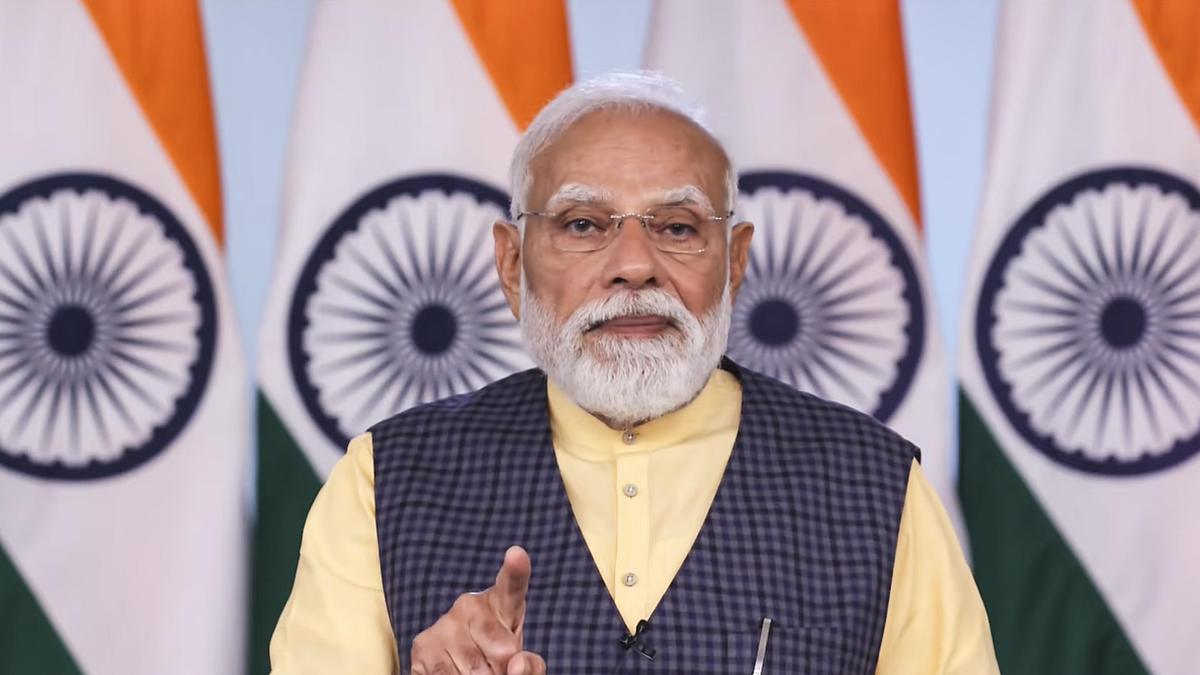
Prime Minister Narendra Modi on Tuesday (March 3, 2026) urged industry leaders to step up investments, embrace emerging technologies and prioritise research to leverage the vast opportunities offered by free trade agreements (FTAs) with various nations.
Addressing a second webinar on Budget 2026-27, the Prime Minister said, the world is now looking for reliable and resilient manufacturing partners, and India has the opportunity to play this role decisively and enhance the country’s participation in the global supply chain.
Union Budget 2026-27 documents
For this, he said, “All stakeholders must invest with confidence, adopt new technologies, and significantly increase investment in research — those days of being frugal in research are over. We must ensure quality in line with global standards. As I often say, when opportunities arise to move ahead, we must have only one mantra — Quality, Quality, Quality.” Stressing that India has entered into free trade agreements with numerous countries, he said, these agreements have opened up a wide range of opportunities for the country.
“In such a situation, our responsibility is that we should never compromise on quality. If there is one area where we must apply maximum strength, intelligence, and focus, it is quality. Our products must meet global standards,” he said.
“For this,” he said, “We need to study the needs and expectations of other countries and conduct thorough research. We must understand the preferences and comfort of consumers in those markets. In today’s competitive world, quality is what gives us a golden opportunity. We must create user-friendly products tailored to their needs.”
“Only then can India truly benefit from the opportunities opened by various free trade agreements, which have created a highway of growth for you,” he said.
Today, the world is seeking reliable and resilient manufacturing partners, he said, adding that India has a strong opportunity to fulfil this role.
“Our direction is clear. Our resolve is clear. Build more, produce more, connect more, and now the need is to export more,” he said.
No direction automatically turns into results, he said, adding that real change happens on the ground when industry, financial institutions, and State Governments work together to translate vision into reality.
He urged participants at the webinar to prioritise key issues such as ways to increase manufacturing and production, make cost structures more competitive, accelerate investment flows, and ensure that development reaches every corner of the country.
As India emerges as a beacon of hope for the world thanks to its robust economy, and as global supply chains undergo transformation, the Prime Minister said, rapid economic development has become the cornerstone for realising the vision of Viksit Bharat.
The goal of a developed India can only be achieved through collective ownership, he said, adding, “The Budget has provided the framework; now you must generate momentum together.”
Stressing that manufacturing, logistics, MSMEs, small and cottage industries, and even small and large cities appear as separate pillars of the economy, he said they are all interconnected.
“Strong manufacturing creates new opportunities and boosts exports. Competitive MSMEs promote flexibility and innovation. Better logistics reduce costs. Well-planned cities attract both investment and talent. This year’s Budget has strengthened all these pillars significantly,” he noted.
Observing that the reforms made in MSME classification have had a wide impact, he said, “enterprises no longer fear that expanding their business will deprive them of government benefits. Continuous efforts have been made to improve MSMEs’ access to credit, promote technology upgrades, and build capacity”. However, he said, the real impact of these efforts will be visible only when MSMEs actively participate in competition with the aim of winning.
“Now is the time for MSMEs to increase productivity, raise quality standards, adopt digital processes, and integrate into strong value chains. Your suggestions in this direction will be extremely important,” he added.
Highlighting the importance of infrastructure and logistics, he said, they serve as fundamental pillars of our growth strategy.
This year’s Budget proposes a record level of capital expenditure to support these priorities, he said.
In the manufacturing sector, he said, India is strengthening its core industrial capabilities while addressing existing challenges.
“By focusing on sectors such as Dedicated Rare Earth Corridors and container manufacturing, we are working to strengthen our trade ecosystem. The Budget has also announced the BioPharma Shakti Mission. The objective of this mission is to make India a global hub in the field of biologics and next-generation therapies. We aim to move toward leadership in advanced biopharma research and manufacturing,” he noted.
Pointing out that a significant transformation is currently underway in the global economy, he said that markets are no longer focused solely on cost; sustainability has become an equally important consideration.
“The Carbon Capture, Utilisation, and Storage Mission is a key initiative driving this shift. Incorporating sustainability into core business strategies is now essential. Industries that invest early in clean technologies will gain better access to emerging markets in the years ahead,” he said.