
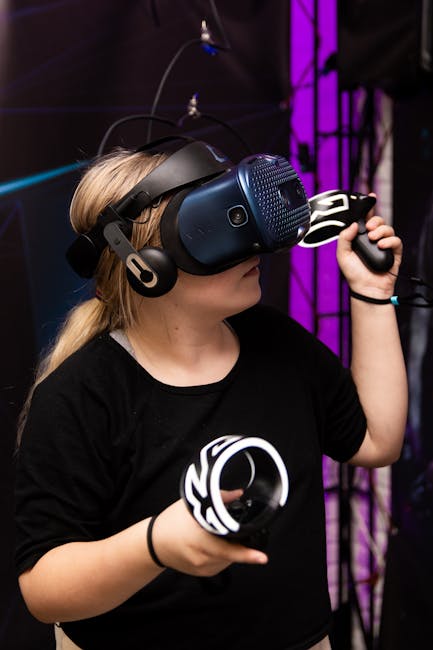
VR Headsets: Your Gateway to Immersive Worlds
Virtual Reality (VR) headsets have transcended their niche origins, evolving into sophisticated devices that offer unparalleled immersion and unlock a universe of experiences. These wearable marvels, once confined to science fiction, now provide a tangible portal to digital realms, revolutionizing entertainment, education, social interaction, and even professional training. Understanding the core technology and the diverse applications of VR headsets is key to appreciating their transformative potential.
At its heart, a VR headset is an intricate piece of technology designed to trick your senses into believing you are present in a simulated environment. This is primarily achieved through stereoscopic displays, typically two small screens positioned in front of each eye, each showing a slightly different perspective of the same scene. This disparity mimics how our brains process visual information from our two eyes, creating a sense of depth and three-dimensionality. High-resolution displays, measured in pixels per eye, are crucial for minimizing the “screen door effect” – the visible grid lines between pixels that can break immersion. Refresh rates, measured in Hertz (Hz), are equally important, with higher rates (90Hz and above) contributing to smoother motion and reducing motion sickness.
Beyond visual stimuli, VR headsets incorporate advanced tracking systems. Inside-out tracking, prevalent in modern standalone headsets like the Meta Quest 2 and Quest 3, uses cameras integrated into the headset itself to map the surrounding environment and the user’s position within it. This eliminates the need for external sensors, offering greater freedom of movement. Outside-in tracking, often found in PC-tethered systems like the Valve Index, utilizes external base stations to track the headset and controllers. Positional tracking allows the headset to accurately register movement in all three dimensions – up/down, left/right, and forward/backward – while rotational tracking captures head turns and tilts.
Audio plays a vital role in VR immersion. Many headsets feature integrated spatial audio, delivering sound that appears to originate from specific directions within the virtual environment. This enhances realism, allowing users to pinpoint the source of sounds and react accordingly, further solidifying the feeling of presence. Haptic feedback, delivered through controllers or even specialized suits, adds another layer of sensory engagement, allowing users to feel virtual textures, impacts, and vibrations.
The evolution of VR headsets has seen a divergence into two main categories: standalone and PC-tethered. Standalone headsets, like the Meta Quest series, are self-contained units that house all necessary processing power, storage, and battery. This offers unparalleled freedom and ease of use, making them accessible to a wider audience. PC-tethered headsets, such as the HTC Vive Pro 2 or Valve Index, connect to a powerful gaming PC, leveraging its processing capabilities for higher fidelity graphics and more demanding experiences. While requiring a dedicated PC, these systems generally offer the most visually stunning and graphically intensive VR applications.
The applications of VR headsets are rapidly expanding beyond gaming. In entertainment, VR offers truly immersive cinematic experiences, allowing viewers to step inside movies and interact with the narrative. Interactive storytelling and virtual theme parks are also emerging, pushing the boundaries of digital entertainment. The education sector is embracing VR for its ability to create engaging and memorable learning environments. Students can explore historical sites, dissect virtual anatomy, or conduct complex scientific experiments in a safe and interactive manner.
The professional world is also witnessing a VR revolution. Architects and designers use VR to visualize and walk through 3D models of buildings before construction, facilitating better design decisions and client presentations. In manufacturing and engineering, VR enables realistic training simulations for complex machinery operation and maintenance, reducing risk and improving efficiency. Healthcare professionals are utilizing VR for surgical training, pain management, and therapeutic applications, offering new avenues for patient care and recovery.
Social VR platforms, such as VRChat and AltspaceVR, are fostering new forms of online interaction. Users can create avatars, explore virtual worlds, attend events, and connect with people from across the globe in a more engaging and personal way than traditional social media. These platforms are fostering communities and offering unique social experiences that bridge geographical divides.
However, the VR landscape is not without its challenges. Motion sickness, while improving with technological advancements, can still be an issue for some users. The cost of entry, particularly for high-end PC-tethered systems, can be a barrier. Furthermore, the development of compelling content, while growing rapidly, needs to continue to keep pace with hardware advancements to fully realize VR’s potential. Eye strain and the need for extended comfort during prolonged use are also ongoing areas of development.
The future of VR headsets is incredibly bright. Expect to see higher resolution displays with wider fields of view, leading to even greater visual fidelity and immersion. Advancements in eye-tracking technology will enable foveated rendering, where only the area the user is looking at is rendered in full detail, improving performance and reducing processing load. Lighter, more comfortable headset designs will enhance usability for extended sessions. The integration of augmented reality (AR) capabilities, creating mixed reality (MR) experiences, will further blur the lines between the physical and digital worlds.
As VR technology matures, it promises to fundamentally alter how we work, play, learn, and connect. The immersive worlds accessible through these headsets are no longer distant dreams but increasingly tangible realities, offering profound opportunities for exploration and engagement. The journey into these digital realms is just beginning, and VR headsets are the indispensable keys unlocking their boundless potential.