
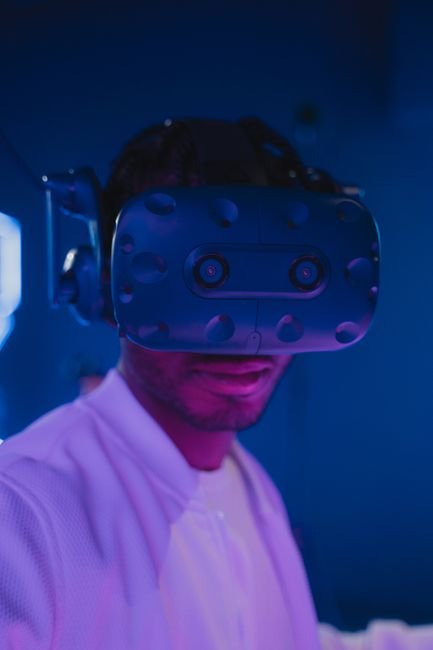
VR Headsets: Revolutionizing Your Gaming Adventures
The landscape of interactive entertainment is undergoing a seismic shift, and at its epicenter lies the Virtual Reality (VR) headset. Once the realm of science fiction, these immersive devices are now a tangible reality, offering gamers an unprecedented level of presence and engagement that transcends traditional screen-based experiences. VR is not merely an upgrade; it’s a fundamental reimagining of how we interact with digital worlds, transforming passive observation into active participation and blurring the lines between the player and the game.
At its core, a VR headset works by presenting stereoscopic images to each eye, mimicking how our brains perceive depth in the real world. This is achieved through a combination of high-resolution displays, specialized lenses, and precise head-tracking technology. When you move your head, the virtual environment moves accordingly, creating a seamless and intuitive sense of immersion. This head-tracking is crucial, as it eliminates the disconnect that can occur with traditional controllers, where your physical actions are translated through a digital intermediary. In VR, your head becomes your primary input device, allowing for naturalistic aiming, looking around corners, and exploring environments with a realism previously unimaginable.
The visual fidelity of modern VR headsets has advanced exponentially. Gone are the days of pixelated, blurry worlds. Current generation headsets boast impressive resolutions, often exceeding 2K per eye, coupled with wider fields of view (FOV) that significantly reduce the “screen door effect” – the visible grid lines between pixels. This enhanced clarity and expansive FOV contribute to a more believable and less fatiguing visual experience, allowing players to truly lose themselves in the game. Furthermore, advancements in refresh rates, typically 90Hz or higher, ensure smooth motion, minimizing motion sickness and further solidifying the illusion of presence.
Beyond visual immersion, VR audio plays an equally vital role. Spatial audio, or 3D audio, is a hallmark of VR gaming. This technology accurately simulates the direction and distance of sounds, allowing players to pinpoint the location of enemies by their footsteps, hear the rustle of leaves behind them, or appreciate the ambient soundscape of a virtual world. This auditory realism adds another layer of depth and immersion, enhancing situational awareness and contributing to the overall believability of the virtual environment.
The types of VR headsets available cater to a spectrum of budgets and technical requirements. PC VR headsets, such as the Valve Index, HTC Vive Pro 2, and Oculus Rift S (though now discontinued, its impact was significant), offer the highest fidelity and performance. They connect to powerful gaming PCs, leveraging their processing power for complex graphics and intricate physics. This allows for the most visually stunning and computationally demanding VR experiences, often featuring advanced tracking systems like external base stations for precise room-scale tracking.
Standalone VR headsets, exemplified by the Meta Quest 2 and Quest 3, have democratized VR gaming. These all-in-one devices house their own processors, displays, and tracking systems, eliminating the need for a PC or external sensors. This portability and ease of use have made VR accessible to a much wider audience. While they may not always match the raw graphical power of PC VR, standalone headsets offer impressive performance and a growing library of high-quality games, making them an excellent entry point into virtual reality.
The impact of VR on gaming genres is profound. First-person shooters (FPS) are perhaps the most obvious beneficiaries. Imagine aiming down sights with your own hands, ducking behind cover in real-time, and physically reloading your weapon. Games like Half-Life: Alyx have set a new benchmark for VR FPS, offering unparalleled immersion and interactive environments. Adventure and exploration games are similarly transformed. Wandering through ancient ruins, scaling virtual mountains, or navigating alien landscapes feels incredibly real when you can physically look around and interact with your surroundings. Titles like Moss and The Walking Dead: Saints & Sinners showcase the potential for narrative-driven VR experiences.
Simulation games also find a natural home in VR. Flight simulators, racing games, and even job simulators benefit immensely from the sense of presence VR provides. Piloting a virtual aircraft with your hands on a virtual yoke, or feeling the G-force of a virtual race car, offers an unparalleled level of realism. Rhythm games, like Beat Saber, have become phenomena, leveraging VR’s intuitive controls and immersive environments to create addictive and physically engaging gameplay.
The input methods in VR are as diverse as the games themselves. Motion controllers are the most common, allowing players to interact with virtual objects using their hands. These controllers typically feature buttons, triggers, and joysticks, alongside tracking that mirrors your hand movements. Hand tracking, a feature becoming increasingly prevalent in standalone headsets, allows for even more natural interaction, enabling players to use their bare hands to grab, point, and manipulate virtual objects without the need for controllers. For certain genres, haptic feedback vests and gloves are also emerging, providing tactile sensations that further enhance immersion, allowing players to feel the impact of virtual explosions or the texture of virtual surfaces.
The growth of VR gaming is intrinsically linked to the development of compelling content. Developers are continually pushing the boundaries of what’s possible in VR, creating experiences that are not only visually impressive but also deeply engaging and innovative. The VR content library is expanding rapidly, encompassing a wide array of genres and experiences, from intense action-packed titles to relaxing puzzle games and captivating narrative adventures.
However, challenges remain. The initial cost of some high-end VR setups can still be a barrier to entry for some consumers. While standalone headsets have significantly lowered the price point, the most premium experiences often require a substantial investment in both hardware and a capable PC. Furthermore, the development of VR games is a complex undertaking, requiring specialized skills and a deep understanding of VR design principles to avoid motion sickness and create truly engaging experiences. As the technology matures and development tools become more accessible, we can expect to see even more sophisticated and immersive VR titles emerge.
The future of VR gaming is undeniably bright. As hardware continues to improve in terms of resolution, FOV, and comfort, and as software development ecosystems mature, VR will undoubtedly become an even more integral part of the gaming landscape. Innovations in areas like eye-tracking, which can enable foveated rendering (rendering only what the user is looking at in high detail, saving processing power) and more intuitive interactions, are on the horizon. The integration of VR with augmented reality (AR) in mixed reality (MR) devices promises even more versatile and blended gaming experiences. VR headsets are no longer a niche curiosity; they are a powerful engine driving the next evolution of interactive entertainment, offering gamers adventures that are not just played, but truly lived.