
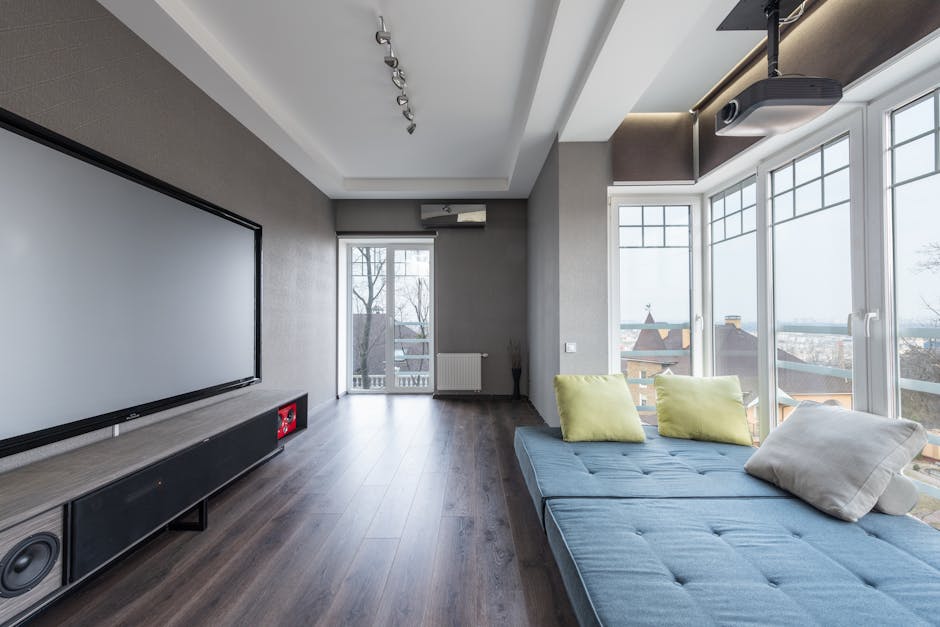
Upgrade Your Living Room: The Ultimate Home Theater Guide
Transforming your living room into a captivating home theater isn’t just about buying the biggest TV; it’s a holistic approach to creating an immersive entertainment sanctuary. This comprehensive guide will walk you through every crucial element, from display technology and audio systems to acoustics and seating, ensuring your upgrade delivers an unparalleled cinematic experience within your own home.
The Foundation: Display Technology
The visual centerpiece of any home theater is its display. The choice here dictates the clarity, color accuracy, and overall impact of your movies, shows, and games.
-
Televisions (TVs): The Modern Standard
- OLED (Organic Light-Emitting Diode): For the ultimate in contrast and black levels, OLED TVs are king. Each pixel emits its own light, allowing for perfect blacks and infinite contrast ratios. This results in stunning detail in dark scenes and vibrant, lifelike colors. They are ideal for dedicated dark rooms.
- QLED (Quantum Dot LED) / Mini-LED: These technologies offer significant improvements over traditional LED TVs. QLED TVs use quantum dots to enhance color volume and brightness, while Mini-LED backlighting provides more precise local dimming, leading to better contrast and reduced blooming compared to standard LED. They excel in brighter rooms.
- Resolution: 4K vs. 8K: While 8K offers four times the pixels of 4K, the benefits are most noticeable on very large screens or when sitting extremely close. For most living rooms, a high-quality 4K TV offers exceptional detail and is more readily available with a wider range of content.
- HDR (High Dynamic Range): This is a critical feature. HDR expands the range of both contrast and color, delivering brighter highlights, deeper blacks, and a more nuanced spectrum of colors. Look for support for HDR10, Dolby Vision, and HLG for the widest compatibility.
- Screen Size: This is subjective but crucial for immersion. A general rule of thumb for 4K is to sit at a distance where the screen fills approximately 30-40 degrees of your field of vision. For a more precise calculation, measure your seating distance in inches and multiply by 0.84 for the ideal screen diagonal in inches (e.g., 100 inches seating distance x 0.84 = 84-inch screen).
-
Projectors: The Cinema Experience
- Types: DLP (Digital Light Processing) and LCD (Liquid Crystal Display) are the primary technologies. DLP often offers better contrast and motion handling, while LCD can provide superior color accuracy. LCoS (Liquid Crystal on Silicon) is a hybrid that combines the benefits of both.
- Resolution: 4K projectors are now widely available and offer incredible detail.
- Brightness (Lumens): Crucial for combating ambient light. For a dedicated dark room, 2000-3000 lumens is usually sufficient. For rooms with some light control, aim for 3000+ lumens.
- Contrast Ratio: Higher contrast ratios result in deeper blacks and more pronounced details in dark scenes.
- Throw Ratio: This determines how far the projector needs to be from the screen to achieve a specific image size. Short-throw projectors are ideal for smaller rooms.
- Screens: A dedicated projector screen is essential for optimal image quality. Choose between fixed-frame, motorized, or manual screens. Screen material (e.g., matte white, gray, acoustic transparent) will also affect brightness, contrast, and color.
The Soul: Audio Systems
Immersive audio is as vital as the visual for a true home theater experience. It draws you into the action and enhances emotional impact.
-
Soundbars: Simplicity and Performance
- Pros: Easy to set up, space-saving, and offer a significant upgrade over TV speakers. Many now support virtual surround sound and Dolby Atmos.
- Cons: Limited by their physical enclosure, making true discrete surround sound challenging.
- Features to look for: Dolby Atmos/DTS:X support, wireless subwoofer, rear satellite speakers, HDMI ARC/eARC for seamless TV integration.
-
AV Receivers (AVRs) and Speaker Systems: The Pinnacle of Immersion
- AV Receiver: The brain of your audio system. It decodes audio formats, powers your speakers, and handles video switching.
- Speaker Configurations:
- 5.1 Surround Sound: The standard, with front left/right, center, surround left/right, and a subwoofer.
- 7.1 Surround Sound: Adds rear surround speakers for even greater immersion.
- Dolby Atmos / DTS:X: These immersive audio formats add height channels, creating a three-dimensional soundscape. Configurations can be 5.1.2 (5 standard, 1 subwoofer, 2 height channels), 7.1.4, and beyond.
- Speaker Types:
- Bookshelf Speakers: Compact and versatile, suitable for front left/right or surround channels.
- Tower Speakers: Larger, floor-standing speakers that offer more bass extension and presence, often used for front left/right.
- Center Channel Speaker: Crucial for dialogue clarity. It should ideally be timbre-matched to your front speakers.
- Surround Speakers: Placed to the sides and/or rear of the listening position.
- Subwoofer: The heart of low-frequency effects (LFE). A good subwoofer adds visceral impact to explosions and deep bass notes.
- Height Speakers: Can be in-ceiling, on-wall (angled down), or upward-firing modules that bounce sound off the ceiling.
Optimizing the Environment: Acoustics and Room Treatment
Even the best equipment can be let down by poor acoustics. Treating your room significantly enhances clarity, detail, and the overall impact of your audio.
- Soundproofing vs. Acoustic Treatment: Soundproofing aims to prevent sound from entering or leaving the room. Acoustic treatment aims to control how sound behaves within the room. For most living rooms, acoustic treatment is the primary focus.
- Reflection Points: Identify where sound waves bounce off hard surfaces (walls, ceiling, floor) and reach your ears. These reflections can cause muddiness, echo, and reduced clarity.
- Absorption: Soft materials like thick curtains, carpets, upholstered furniture, and dedicated acoustic panels absorb sound energy, reducing reflections.
- Diffusion: Diffusers scatter sound waves, breaking up harsh reflections and creating a more natural and spacious sound. This can be achieved with bookshelves filled with irregularly shaped objects or dedicated acoustic diffusers.
- Bass Traps: Low frequencies are notoriously difficult to control. Bass traps, typically placed in corners, absorb excess bass energy and prevent boomy or uneven bass response.
- Speaker Placement: Proper speaker placement is paramount. Follow the Dolby or DTS guidelines for your specific surround sound configuration. Ensure your center channel is at ear level and your front speakers are equidistant from the center and at a slight toe-in towards the listening position.
Comfort and Convenience: Seating and Lighting
The final touches that elevate your living room into a true home theater are comfortable seating and optimized lighting.
-
Seating:
- Recliners: Plush, comfortable recliners designed for home theaters offer the ultimate in relaxation and immersion.
- Theater Seating: Modular seating systems allow for custom configurations and often include features like cup holders and reclining mechanisms.
- Sofa and Chairs: Even if you don’t opt for dedicated theater seating, ensure your existing furniture is comfortable for extended viewing sessions. Consider the viewing angles and ensure everyone has a clear line of sight to the screen.
-
Lighting Control:
- Dimming Capabilities: The ability to dim lights is essential for creating a cinematic atmosphere. Consider dimmable LED bulbs or smart lighting systems.
- Ambient Lighting: Soft, indirect lighting can be used to illuminate the room without distracting from the screen. LED strip lighting behind the TV or along the ceiling can create a pleasing ambiance.
- Task Lighting: Small, directional lights can be useful for navigating the room or finding remotes without disrupting the viewing experience.
- Blackout Curtains: Crucial for controlling ambient light, especially if your living room receives a lot of natural light.
Connectivity and Control: The Backbone of Your System
Seamless integration and intuitive control are key to a frustration-free home theater experience.
- HDMI Cables: Use high-quality, certified HDMI cables that support the latest standards (e.g., HDMI 2.1) for 4K/8K resolutions, high refresh rates, and HDR.
- Streaming Devices: Apple TV, Roku, Amazon Fire TV Stick, and Nvidia Shield offer access to a vast library of streaming content in high quality.
- Universal Remotes: Consolidate control of all your devices (TV, AVR, streaming box, Blu-ray player) into one easy-to-use remote. Smart remotes can even be programmed with macros for complex actions.
- Smart Home Integration: Integrate your home theater system with voice assistants like Alexa or Google Assistant for hands-free control.
By carefully considering each of these elements, you can meticulously upgrade your living room into a high-performance