
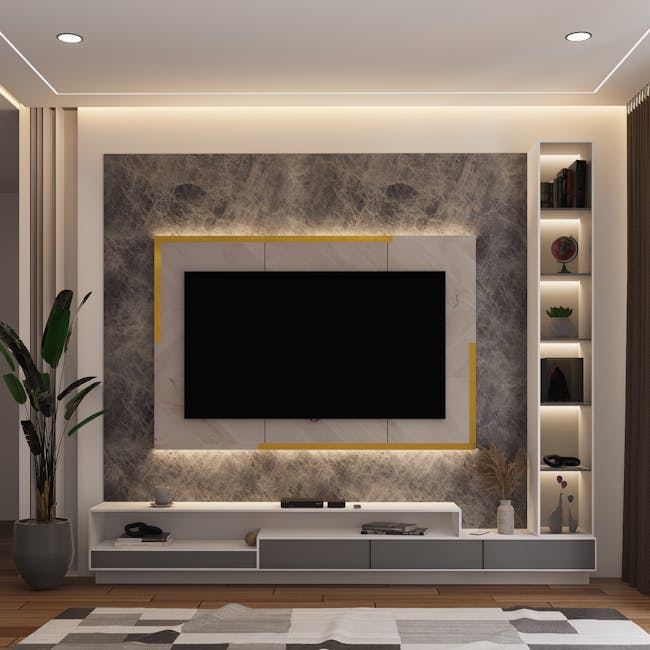
The shimmering rectangle has dominated living rooms for decades, a portal to entertainment and information. But the familiar black bezel, once a defining characteristic of television sets, is rapidly becoming a relic of the past. The future of television is unequivocally frameless, and the driving force behind this sleek revolution is the relentless advancement of LED display technology. This isn’t merely an aesthetic upgrade; it’s a fundamental shift in how we experience visual content, blurring the lines between the screen and the world around it.
The transition to borderless LED TVs is not an overnight phenomenon. It’s the culmination of years of innovation in panel manufacturing, backlight engineering, and sophisticated processing. Historically, bezels served a crucial practical purpose. They housed essential components like speakers, provided structural integrity to the display, and protected the delicate screen edges from damage. However, as LED technology matured, these functionalities have been ingeniously integrated into the chassis or moved to external soundbars, freeing the display itself to become the singular focus.
One of the primary catalysts for the frameless design is the evolution of LED backlighting. Early LED TVs relied on bulky CCFL (Cold Cathode Fluorescent Lamp) backlights, which necessitated significant space around the panel. The advent of edge-lit and, more significantly, direct-lit LED backlighting revolutionized this. Edge-lit designs, where LEDs are placed along the edges of the screen and light is diffused across the panel, allowed for dramatically thinner televisions, paving the way for reduced bezels. Direct-lit technology, where LEDs are positioned directly behind the entire screen area, offers superior brightness and contrast control, but its true triumph lies in enabling the complete elimination of the frame. By precisely controlling the placement and intensity of individual LED zones, manufacturers can achieve uniform illumination without the need for a physical border to guide light.
Furthermore, the physical construction of LED panels has become more robust. Advanced manufacturing techniques allow for thinner, more durable glass or plastic substrates, reducing the need for a substantial protective frame. The structural integrity is now often provided by the rear chassis of the television, which can be engineered to support the display without requiring a prominent front bezel. This shift has allowed designers to push the boundaries, moving from thick, obtrusive frames to virtually invisible borders.
The impact on the viewing experience is profound and multifaceted. The most immediate benefit of a borderless TV is the immersive quality it imparts. When the image extends to the very edges of the display, the viewer’s attention is drawn entirely to the content. This creates a more cinematic and engaging experience, pulling you deeper into movies, sports, and games. The absence of a visual interruption means that the on-screen action feels more expansive and lifelike. Imagine watching a sweeping landscape or a high-octane car chase; the frameless design amplifies the sense of scale and drama, making the television feel less like a device and more like a window.
Beyond pure immersion, borderless designs offer practical advantages in terms of space utilization. In a world where living spaces are often at a premium, a television with a reduced or non-existent bezel allows for a larger screen size within a similar footprint. This means you can potentially upgrade to a bigger TV without needing to reconfigure your existing entertainment setup. For wall-mounted installations, the frameless aesthetic creates a cleaner, more integrated look, making the TV appear as if it’s floating on the wall. This minimalist approach aligns perfectly with modern interior design trends that favor sleekness and uncluttered spaces.
The technology underpinning this borderless revolution also extends to the display’s internal components. Speakers, once often integrated into the bezel, are now frequently designed as down-firing or rear-firing units, or as separate soundbars. This separation allows for better audio performance and, crucially, liberates the front of the display from bulky speaker grilles. Similarly, the internal circuitry and power supplies have become more compact and efficient, further reducing the need for a large housing.
Moreover, the evolution of panel technology itself plays a significant role. Technologies like OLED (Organic Light-Emitting Diode), while distinct from LED in their light emission method, have also championed the frameless aesthetic and influenced LED TV design. OLED panels inherently have no backlight, allowing for incredibly thin designs and, consequently, minimal bezels. This success has undoubtedly pushed LED manufacturers to achieve similar levels of sleekness and visual purity.
The manufacturing processes for LED panels have also become more precise. The ability to create incredibly thin and uniform layers of pixels, coupled with advanced adhesive and bonding techniques, allows the display to be seamlessly integrated with minimal structural support around the edges. This precision engineering is what allows manufacturers to confidently remove the protective frame without compromising the panel’s integrity.
The marketing and consumer demand for these borderless televisions are also accelerating the trend. Consumers are increasingly drawn to the sleek, modern aesthetic that frameless TVs offer. They represent a leap forward in design, signaling a more sophisticated and integrated approach to home entertainment. Manufacturers have responded by prominently featuring the borderless aspect in their advertising, highlighting the immersive experience and minimalist elegance.
Looking ahead, the trend towards frameless displays is likely to continue and evolve. We may see even thinner panels, perhaps utilizing flexible display technologies that can be integrated into curved surfaces or even rolled up. The concept of a “bezel” may disappear entirely, replaced by a continuous, uninterrupted visual surface. This could lead to entirely new forms of display technology and integration within our homes and environments.
The journey from the bulky CRT televisions of yesteryear to the ethereal, borderless LED screens of today is a testament to human ingenuity and the relentless pursuit of a more immersive and aesthetically pleasing visual experience. The frameless LED TV is not just a technological advancement; it’s a paradigm shift, redefining our relationship with the screen and ushering in an era where the content truly takes center stage, unhindered by the limitations of its frame. This evolution is a clear indicator that the future of television is about eliminating boundaries, both physically and perceptually, and the borderless LED TV is the vanguard of this exciting new frontier.