
The flickering glow of cathode ray tubes gave way to the crisp pixels of high-definition displays, and the simple joy of button mashing evolved into complex, immersive virtual worlds. The journey of gaming consoles is a captivating narrative of technological innovation, cultural impact, and the relentless pursuit of interactive entertainment. From rudimentary circuits to sophisticated supercomputers, each generation has pushed the boundaries of what’s possible, shaping not just how we play, but how we connect and experience digital realities.
Our odyssey begins with the pioneers. In the early 1970s, the concept of home video gaming was nascent. Ralph H. Baer, often hailed as the “Father of Video Games,” developed the “Brown Box,” a prototype that laid the groundwork for the first home console: the Magnavox Odyssey in 1972. This rudimentary device, lacking sound and relying on plastic overlays for visual variety, offered simple games like tennis and hockey. Its impact was profound, demonstrating the commercial viability of interactive entertainment within the living room. The ensuing “Pong” arcade phenomenon, brought home by Atari in 1975, further solidified this nascent market, its iconic bleeps and bloops becoming synonymous with early gaming.
The true dawn of the console era arrived with the Atari 2600 (originally the Atari VCS) in 1977. This cartridge-based system revolutionized the industry, offering a library of interchangeable games that brought arcade experiences home. Titles like “Space Invaders,” “Pac-Man,” and “Adventure” became cultural touchstones, selling millions of units and establishing the console as a mainstream entertainment medium. The Atari 2600 fostered a generation of gamers, its blocky graphics and simple yet addictive gameplay leaving an indelible mark. However, a market flooded with low-quality titles led to the infamous video game crash of 1983, a period of significant decline for the industry.
Emerging from the ashes of the crash, Nintendo revitalized the industry with the Nintendo Entertainment System (NES) in 1985. This console, with its strict quality control and iconic franchises like “Super Mario Bros.” and “The Legend of Zelda,” re-established consumer trust. The NES introduced precise controls, more sophisticated graphics, and compelling narratives, setting a new standard for game design. Its success was so immense that it effectively ended the reign of Atari and ushered in the 8-bit era. Sega, a formidable competitor, entered the fray with its Master System, offering its own unique library of games, though it struggled to dethrone Nintendo in many markets.
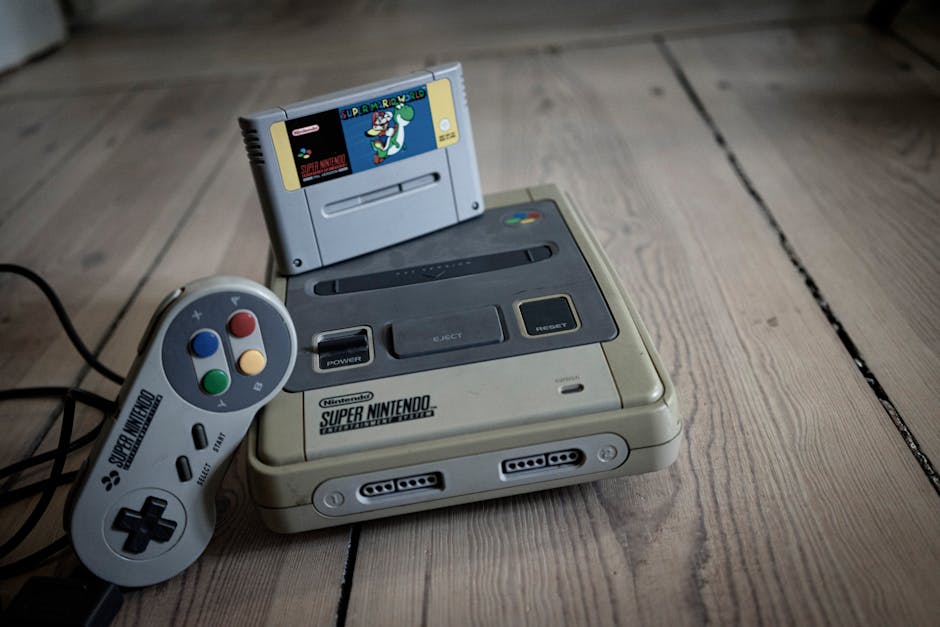
The transition to the 16-bit era saw intense rivalry, primarily between Nintendo’s Super Nintendo Entertainment System (SNES, 1990) and Sega’s Genesis (1989). This generation was defined by enhanced graphics, superior sound, and more complex gameplay. The SNES boasted advanced graphical capabilities, supporting Mode 7 scaling and rotation, which enabled breathtaking visual effects in titles like “Super Mario Kart” and “F-Zero.” The Genesis, with its faster processor, offered a grittier, more arcade-like experience, championed by the iconic “Sonic the Hedgehog.” This fierce competition spurred innovation, with both companies releasing groundbreaking titles that continue to be celebrated today.
The mid-1990s marked a seismic shift with the advent of 3D graphics and CD-ROM technology. Sony, initially a partner with Nintendo for a CD add-on, entered the market independently with the PlayStation (1994). The PlayStation’s affordability, extensive third-party support, and mastery of 3D polygonal graphics propelled it to dominance. Games like “Final Fantasy VII,” “Metal Gear Solid,” and “Crash Bandicoot” showcased the potential of this new dimension, captivating audiences with cinematic storytelling and immersive gameplay. Nintendo responded with the Nintendo 64 (1996), which, despite its cartridge-based format and limited CD support, delivered impressive 3D experiences with titles like “Super Mario 64” and “The Legend of Zelda: Ocarina of Time,” establishing analog control for 3D movement. Sega’s Saturn, while technologically capable, struggled to compete against the PlayStation’s momentum.
The turn of the millennium ushered in the sixth generation, characterized by DVD technology, online capabilities, and a further leap in graphical fidelity. Sony’s PlayStation 2 (2000) became the best-selling console of all time, its backward compatibility with PS1 titles and a vast library of games, including “Grand Theft Auto III” and “Shadow of the Colossus,” securing its legendary status. Microsoft entered the console arena with the Xbox (2001), a powerful machine that emphasized online gaming with Xbox Live and introduced the iconic “Halo: Combat Evolved.” Nintendo, meanwhile, continued its innovative path with the GameCube (2001), offering a unique design and a curated selection of beloved franchises.
The seventh generation, beginning in the mid-2000s, witnessed the rise of high-definition gaming and motion controls. Sony’s PlayStation 3 (2006) and Microsoft’s Xbox 360 (2005) pushed graphical boundaries with their HD output and sophisticated online services. The Xbox 360, with its robust Xbox Live network, became a hub for multiplayer gaming. The PlayStation 3, powered by the Cell processor, offered cutting-edge graphics and the Blu-ray format. Nintendo once again disrupted the market with the Wii (2006), its intuitive motion controls appealing to a broader, more casual audience, making games like “Wii Sports” a global phenomenon.
The eighth generation saw the continued refinement of existing technologies and the emergence of new paradigms. Sony’s PlayStation 4 (2013) and Microsoft’s Xbox One (2013) focused on enhanced graphical power, seamless online integration, and a growing emphasis on digital distribution. The PS4, with its strong exclusive titles, gained significant market share. The Xbox One, initially positioned as an all-in-one entertainment device, evolved to embrace a more gaming-centric approach. Nintendo’s Wii U (2012) struggled to find its footing, but it paved the way for the revolutionary Nintendo Switch (2017). The Switch’s hybrid design, allowing for both home console and portable play, proved immensely popular, revitalizing Nintendo’s standing with titles like “The Legend of Zelda: Breath of the Wild” and “Super Mario Odyssey.”
The current, ninth generation, represented by the PlayStation 5 (2020) and Xbox Series X/S (2020), is defined by lightning-fast solid-state drives, ray tracing for realistic lighting, and 4K resolution gaming. These consoles offer unparalleled loading speeds and visual fidelity, further blurring the lines between gaming and reality. The focus remains on expanding online ecosystems, subscription services like Xbox Game Pass and PlayStation Plus, and the continued growth of cross-platform play, fostering a more connected and accessible gaming landscape than ever before. The evolution of gaming consoles is a testament to human ingenuity, a constant drive to create more engaging, immersive, and shared experiences.