
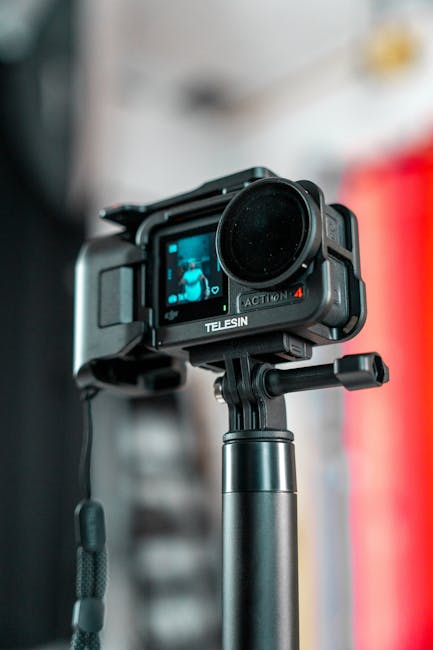
Action Camera Buying Guide: Unveiling the Perfect Adventure Companion
The world of action cameras has exploded, offering rugged, compact devices capable of capturing life’s most exhilarating moments in stunning detail. Whether you’re a seasoned thrill-seeker, a travel enthusiast, or simply want to document everyday adventures, choosing the right action camera can feel overwhelming. This comprehensive guide will dissect the key features to consider, empowering you to make an informed decision and find the perfect companion for your next escapade.
Resolution and Frame Rates: The Foundation of Clarity
At the heart of any action camera lies its ability to capture high-quality video. Resolution dictates the sharpness and detail of your footage. Most modern action cameras offer 4K resolution (3840 x 2160 pixels) as standard, providing incredibly crisp and lifelike images. Some high-end models even boast 5K or 8K, offering even greater fidelity, though the benefits may be less noticeable on standard displays and require more processing power. For most users, 4K is the sweet spot, offering excellent detail without overwhelming file sizes.
Beyond resolution, frame rate is crucial for smooth motion. Measured in frames per second (fps), a higher frame rate results in smoother video, especially during fast-paced action. Standard video is typically recorded at 24fps or 30fps. For capturing slow-motion replays, look for cameras that can shoot at higher frame rates. 60fps at 4K is becoming increasingly common, while 120fps or even 240fps at 1080p (Full HD) unlocks dramatic slow-motion possibilities. Consider what type of footage you intend to capture; if epic slow-motion is your goal, prioritize higher frame rate options at your desired resolution.
Sensor Size and Image Stabilization: Capturing Stability in Chaos
The sensor size plays a significant role in image quality, particularly in low-light conditions. Larger sensors can gather more light, leading to brighter, less noisy images. While action cameras are generally designed for bright outdoor conditions, a larger sensor can still make a difference when shooting during dawn, dusk, or in shaded environments. However, sensor size is often a trade-off with overall camera size and cost, so it’s a feature to balance with other priorities.
Image stabilization (IS) is perhaps the most critical feature for action cameras. These devices are designed to be mounted on helmets, bikes, cars, or held in hand during dynamic activities. Without effective IS, your footage will be shaky and unwatchable. There are two primary types: optical image stabilization (OIS), which physically moves the lens to counteract shakes, and electronic image stabilization (EIS), which digitally analyzes and corrects camera movement. Many modern cameras utilize advanced EIS, often referred to by proprietary names like HyperSmooth (GoPro) or RockSteady (DJI). The effectiveness of EIS can vary, with higher-end systems offering near-gimbal-like smoothness. Look for reviews that specifically test the stabilization capabilities of cameras you’re considering. Some cameras also offer a combination of OIS and EIS for ultimate stability.
Durability and Waterproofing: Built for the Elements
The very essence of an action camera is its ability to withstand rugged environments. Durability is paramount. Most action cameras are built with robust, shock-resistant materials. However, the level of protection can vary. Many cameras are inherently waterproof to a certain depth, while others require a separate waterproof housing.
Waterproofing is a key differentiator. If you plan to dive, surf, or engage in water sports, a camera with excellent built-in waterproofing is essential. Check the depth rating and ensure it meets your needs. For casual splashes or rain, a water-resistant camera might suffice. If you’re venturing into extreme depths, investing in a high-quality, dedicated waterproof housing is crucial. Always verify the IP rating (Ingress Protection) for dust and water resistance.
Field of View (FOV) and Lens Options: Capturing the Grandeur
Action cameras are renowned for their wide-angle lenses, allowing you to capture a vast expanse of your surroundings. This Field of View (FOV) is typically measured in degrees. A wider FOV (e.g., 170 degrees) gives you a more immersive, fisheye-like perspective, perfect for capturing expansive landscapes or fitting more action into the frame. Narrower FOVs can be useful for more focused shots or to reduce distortion. Some cameras offer adjustable FOV settings, allowing you to switch between wide, medium, and narrow perspectives.
Some action cameras also offer interchangeable lens options, providing even greater creative flexibility. While not as common as on DSLRs, this feature can be a significant advantage for specialized shooting scenarios.
Battery Life and Storage: Powering Your Adventures
Capturing extended adventures requires sufficient battery life. Action cameras are notorious power consumers, especially when recording at high resolutions and frame rates. Look for cameras with easily swappable batteries. This allows you to carry spare batteries and quickly swap them out to keep filming without interruption. Consider the typical recording times at your preferred settings and factor in the need for multiple batteries for longer excursions.
For storing your high-resolution footage, storage capacity is vital. Action cameras typically use microSD cards. Ensure the camera supports the desired card class and capacity. High-resolution video files are large, so a larger capacity card (e.g., 128GB or 256GB) is often recommended. Consider the write speeds of the microSD card as well; faster cards are essential for smooth recording at high bitrates.
Audio Quality: Capturing the Sounds of the Action
While visual fidelity is paramount, don’t overlook audio quality. Action cameras often have built-in microphones designed to capture the sounds of your environment. However, wind noise can be a significant issue when filming outdoors at speed. Look for cameras with advanced wind-noise reduction technology or consider external microphone options for superior audio capture. Some cameras offer stereo microphones for more immersive sound.
Connectivity and Smart Features: Enhancing Your Workflow
Modern action cameras are packed with connectivity options. Wi-Fi and Bluetooth are standard, allowing you to connect to your smartphone or tablet. This enables remote control of the camera, live preview, and fast transfer of footage. Many manufacturers offer dedicated mobile apps that provide a user-friendly interface for managing your camera and editing your videos.
Other smart features to consider include GPS for geotagging your footage, voice control for hands-free operation, and built-in editing software. These features can streamline your workflow and enhance your overall experience.
Price and Brand Reputation: Making the Right Investment
Action cameras span a wide price range, from budget-friendly options to premium professional-grade devices. Price is often a reflection of the features, performance, and build quality. Set a budget before you start shopping and prioritize the features that are most important to your intended use.
Established brands like GoPro, DJI, and Insta360 have built strong reputations for their action camera offerings. Researching user reviews and professional comparisons can help you gauge the reliability and performance of different brands and models. Don’t be afraid to explore lesser-known brands, as they can sometimes offer excellent value for money.
By carefully considering these key aspects, you can navigate the exciting world of action cameras and find the perfect device to capture your next great adventure.
