
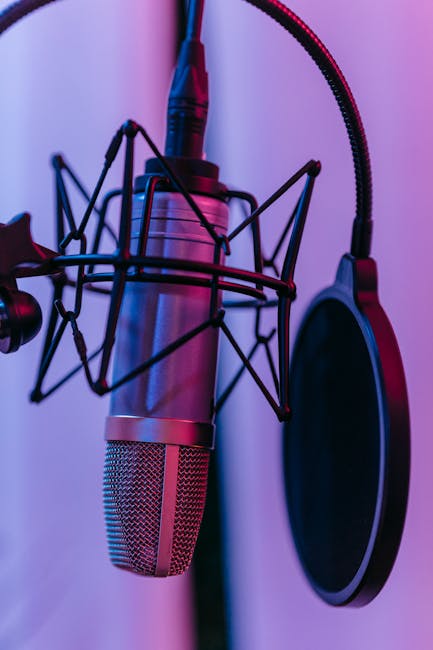
Professional Sound, Professional Results: Mastering YouTube with Condenser Microphones
For aspiring YouTubers and seasoned content creators alike, achieving professional-grade audio is no longer a luxury; it’s a necessity. Viewers are increasingly discerning, and poor sound quality can be a swift exit strategy from your channel. While built-in microphones on cameras and smartphones offer convenience, they rarely deliver the clarity, depth, and richness that truly captivates an audience. This is where the power of condenser microphones for YouTube comes into play. These sensitive transducers are designed to capture nuanced audio, transforming amateur recordings into polished productions.
Condenser microphones, often referred to as capacitor microphones, operate on a different principle than their dynamic counterparts. They utilize a diaphragm that is part of an electrical capacitor. When sound waves strike the diaphragm, they cause it to vibrate, altering the distance between it and a fixed backplate. This change in distance varies the capacitance, which in turn generates an electrical signal. This process allows condensers to capture a wider frequency range and finer details, making them ideal for spoken word, vocals, and instruments where subtle nuances are crucial.
The primary advantage of using a condenser microphone for YouTube content lies in its superior sensitivity and accuracy. They can pick up quieter sounds and reproduce high frequencies with greater fidelity than dynamic mics. This translates to a clearer, more present vocal recording, allowing your personality to shine through without being masked by background noise or a dull tone. For creators who rely on their voice to convey information, tell stories, or entertain, this sonic clarity is paramount. Imagine a detailed product review where the subtle click of a button or the rustle of packaging is lost – a condenser mic ensures these sonic textures are present, adding to the immersive experience.
When selecting a condenser microphone for your YouTube setup, several key factors warrant consideration. Firstly, polar patterns play a significant role. The most common and often most useful for solo YouTubers is the cardioid pattern. This pattern picks up sound primarily from the front, while rejecting sound from the sides and rear. This directional focus is invaluable for isolating your voice from room noise and other distractions. For interview-style content or collaborations, a bidirectional (figure-8) pattern can be useful, capturing sound from both the front and rear, while rejecting the sides. However, for most single-person YouTube channels, cardioid remains the gold standard.
Secondly, diaphragm size is another important characteristic. Condenser mics come with either large or small diaphragms. Large-diaphragm condenser (LDC) microphones are generally favored for their warm, rich sound and ability to capture subtle details. They are often the go-to choice for studio vocal recordings and are excellent for YouTube content where vocal presence and a polished tone are desired. Small-diaphragm condenser (SDC) microphones, while also capable of excellent detail, tend to have a more accurate and linear frequency response, often excelling at capturing transient sounds and nuances in instruments. While LDCs are more prevalent for YouTube vocals, SDCs can be excellent for capturing ambient room sound or specific instrumental performances.
Thirdly, connectivity is a crucial practical consideration. The two primary connection types for condenser microphones are XLR and USB. XLR microphones are the industry standard in professional audio. They offer superior sound quality and flexibility but require an audio interface or mixer to connect to your computer. This setup provides more control over your audio signal and often allows for phantom power (essential for condenser mics) to be delivered cleanly. USB microphones, on the other hand, offer plug-and-play simplicity. They connect directly to your computer via USB and have a built-in preamplifier and analog-to-digital converter. For beginners or those prioritizing ease of use, a USB condenser mic can be an excellent starting point, offering a significant upgrade over built-in mics without the complexity of an external audio interface.
Fourthly, phantom power is a non-negotiable requirement for most condenser microphones. This is a DC electrical voltage, typically 48 volts, supplied through the XLR cable from the audio interface or mixer. It powers the internal circuitry of the condenser capsule. USB microphones typically provide phantom power internally, so it’s not something the user needs to worry about. However, for XLR users, ensuring your audio interface or mixer can provide phantom power is essential.
When it comes to specific use cases on YouTube, condenser mics excel in various content formats. For vloggers and talking-head creators, a well-placed cardioid condenser mic, such as a large-diaphragm USB model, can deliver incredibly clear and present vocals, making your message resonate with viewers. The ability to capture subtle vocal inflections adds personality and authenticity to your delivery.
For gamers and streamers, a condenser mic can elevate the audio experience beyond just game sounds. Clear commentary is vital for engaging viewers, and a condenser mic ensures your reactions, strategies, and personality are heard with pristine clarity, even during intense gameplay. Many streamers opt for USB condenser mics placed strategically on a boom arm to keep their face clear.
Musicians and producers creating content on YouTube will find condenser microphones indispensable. Whether recording vocals, acoustic instruments, or even capturing room ambiance for a larger sound, the detail and accuracy of condensers are critical for professional-sounding music. LDCs are often favored for vocals, while SDCs can be excellent for acoustic guitars or drum overheads.
The recording environment is as important as the microphone itself. Even the best condenser mic will struggle in a poorly treated room. Echoes, reverberations, and background noise can detract significantly from your audio. Simple acoustic treatments, such as hanging blankets, placing acoustic foam panels, or even recording in a closet filled with clothes, can make a dramatic difference. For YouTubers, aiming for a “dead” room, where sound reflections are minimized, will allow the condenser mic to capture your voice cleanly without picking up unwanted room coloration.
Placement and positioning are also key to unlocking the full potential of a condenser microphone. For vocal recording, the “sweet spot” is typically a few inches from the microphone. Using a pop filter is highly recommended to mitigate plosive sounds (harsh “p” and “b” sounds) that can overload the diaphragm and cause unpleasant distortion. Experimenting with mic height and angle can also help tailor the sound to your voice and reduce the pickup of unwanted room noise. For instance, angling the microphone slightly off-axis can sometimes reduce sibilance (harsh “s” sounds).
Maintenance and care for condenser microphones are also important. They are generally more delicate than dynamic microphones. Avoid dropping them, exposing them to extreme temperatures or humidity, and always store them in their protective cases when not in use. Cleaning the grille gently with a soft, dry brush can help prevent dust buildup that could affect sound quality.
The investment in a quality condenser microphone for your YouTube channel is an investment in your content’s professionalism and your audience’s engagement. While the initial cost might seem higher than basic options, the sonic improvement is undeniable and will pay dividends in terms of viewer retention and channel growth. From the subtle whisper to the clear enunciation, a condenser microphone captures the full spectrum of your audio, ensuring your message is heard, understood, and appreciated. The digital landscape of content creation demands a high standard, and for YouTubers seeking to stand out, a professional condenser microphone is an essential tool in their arsenal, delivering professional results that resonate with a global audience.