
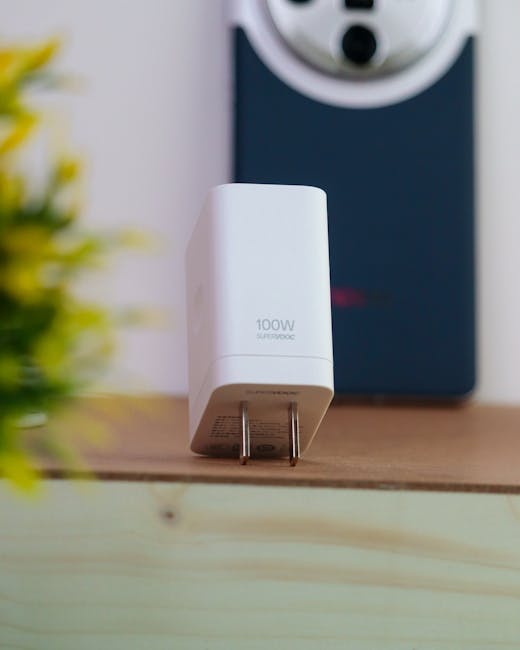
Fast Charger: Power Up Your Devices in Minutes
In today’s hyper-connected world, battery life is no longer a luxury; it’s a necessity. From smartphones and tablets to laptops and wearables, our devices are extensions of ourselves, and a dead battery can bring our productivity and entertainment to a grinding halt. This is where the revolutionary fast charger comes into play, transforming the frustrating wait for a full charge into a matter of minutes. Understanding the technology behind these powerhouses and how to leverage them effectively can significantly enhance your digital life.
The core principle behind fast charging lies in delivering more power to your device’s battery in a shorter amount of time. Traditional chargers typically operate at lower wattages, slowly trickling power into the battery. Fast chargers, however, employ advanced charging protocols and higher voltage and amperage outputs to significantly accelerate this process. This isn’t just about convenience; it’s about intelligent power delivery designed to optimize charging speed without compromising battery health.
Several key technologies underpin the rapid charging capabilities we see today. Qualcomm Quick Charge (QC) has been a dominant force, with multiple iterations (QC 3.0, QC 4+, QC 5) offering progressively faster charging speeds and improved efficiency. QC 4+ and later versions are particularly noteworthy for their ability to dynamically adjust voltage and current based on the device’s needs, minimizing heat generation and maximizing charge rate. Another significant player is USB Power Delivery (USB PD), an open standard that allows for higher power output and bidirectional charging, meaning a device can both receive and supply power. USB PD is particularly prevalent in modern smartphones, tablets, and laptops, offering a universal charging solution.
Beyond these prominent standards, manufacturers often develop their own proprietary fast-charging technologies. Samsung’s Super Fast Charging, OnePlus’s Warp Charge, and Oppo’s VOOC/SuperVOOC are prime examples. These proprietary systems are meticulously optimized for their specific device ecosystems, often achieving remarkable charging speeds by leveraging unique hardware and software combinations. While they may not be universally compatible with all devices, they represent the cutting edge of mobile charging innovation.
The benefits of adopting a fast charger are manifold. The most obvious is the dramatic reduction in charging time. Imagine needing to leave for an important meeting and realizing your phone is at 10%. With a fast charger, you could potentially gain hours of battery life in just 15-30 minutes, eliminating the anxiety of a dying device. This is invaluable for professionals, students, and anyone who relies heavily on their mobile devices throughout the day.
Furthermore, fast chargers can contribute to a more streamlined and less cluttered charging setup. Instead of needing multiple chargers for different devices, a high-wattage USB PD charger can often power your smartphone, tablet, and even a compatible laptop, consolidating your charging needs. This is especially beneficial for travelers who aim to pack light.
However, it’s crucial to understand that not all fast chargers are created equal, and compatibility is paramount. To achieve the advertised fast-charging speeds, your device must support the specific fast-charging protocol used by the charger. For instance, a phone that only supports Qualcomm Quick Charge 3.0 will not benefit from the full speed of a charger designed for Quick Charge 5 or USB PD. Always check your device’s specifications or the charger’s packaging to ensure compatibility.
The quality of the charging cable also plays a critical role. A low-quality cable can act as a bottleneck, preventing the charger from delivering its full potential power. For optimal fast-charging performance, it’s recommended to use the original charging cable that came with your device or a certified high-quality cable that supports the required power delivery standards. Look for cables rated for higher amperages and voltages, often indicated by USB-IF certification.
Heat management is another vital aspect of fast charging. When more power is pushed into a battery, it generates heat. While modern fast-charging technologies are designed to mitigate this, excessive heat can degrade battery health over time. Reputable fast chargers incorporate intelligent heat dissipation mechanisms and temperature sensors to prevent overheating. It’s also advisable to avoid charging your device in direct sunlight or enclosed spaces where ventilation is poor. Allowing your device to cool down naturally is always a good practice.
The evolution of fast charging is ongoing. We are witnessing the development of even faster charging technologies, with some manufacturers pushing the boundaries towards charging times measured in mere minutes. This progress is driven by advancements in battery chemistry, power management ICs (integrated circuits), and charging protocols. The future promises even more efficient and rapid ways to keep our devices powered.
When selecting a fast charger, consider your primary devices and their charging needs. If you primarily use a modern smartphone that supports USB PD, a robust USB PD charger is an excellent investment. If you have multiple devices from a specific manufacturer that utilizes a proprietary fast-charging technology, their branded charger might offer the best performance for those devices. For universal compatibility and high power output, a charger with support for multiple protocols like USB PD and Qualcomm Quick Charge is a wise choice.
The wattage of a charger is a key indicator of its charging speed potential. For smartphones, chargers ranging from 18W to 65W are common for fast charging. For laptops, you might need 65W, 100W, or even higher, depending on the laptop’s power requirements. Always ensure the charger’s wattage meets or exceeds your device’s recommended charging wattage.
In conclusion, fast chargers have revolutionized how we power our devices, transforming the once-tedious process of charging into a rapid and efficient experience. By understanding the underlying technologies, ensuring compatibility, and using quality accessories, you can harness the full potential of fast charging and keep your digital life seamlessly connected, anytime, anywhere. The days of waiting hours for a full battery are rapidly becoming a relic of the past, thanks to the power and innovation of fast chargers.