
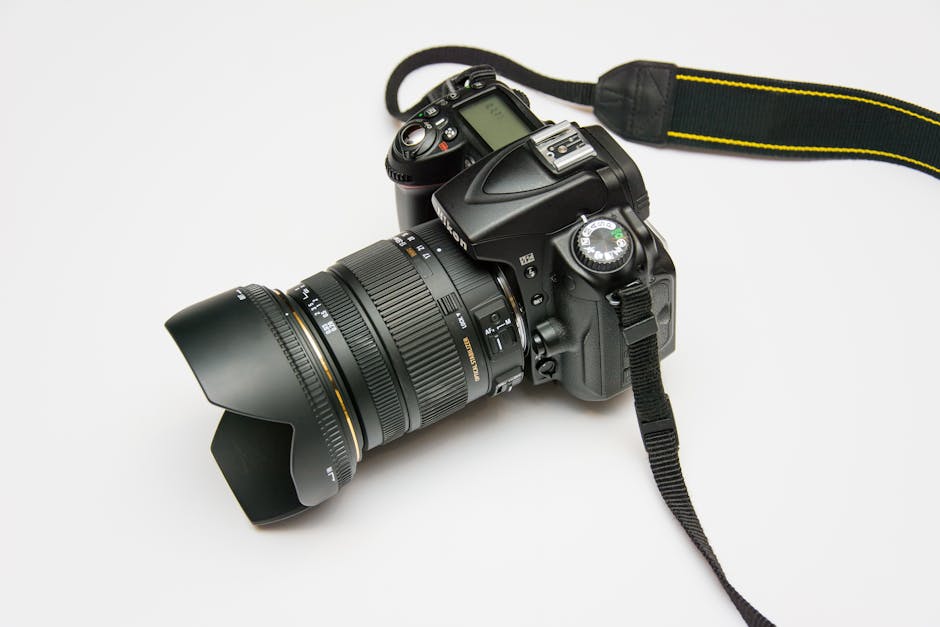
Master Your DSLR: Essential Tips for Stunning Photography
Unlocking the full potential of your Digital Single-Lens Reflex (DSLR) camera is a journey that transforms casual snapshots into breathtaking works of art. While automatic modes offer convenience, understanding the core principles and mastering your DSLR’s capabilities will elevate your photography to new heights. This comprehensive guide provides essential tips, from fundamental settings to creative techniques, designed to empower you to capture stunning images.
1. Embrace the Exposure Triangle: Aperture, Shutter Speed, and ISO
The bedrock of photographic control lies within the exposure triangle: aperture, shutter speed, and ISO. Understanding their interplay is paramount.
-
Aperture (f-stop): Controls the amount of light entering the lens and, crucially, the depth of field. A wide aperture (small f-number, e.g., f/1.8) allows more light and creates a shallow depth of field, blurring the background to isolate your subject. A narrow aperture (large f-number, e.g., f/16) allows less light and renders everything from foreground to background in sharp focus. This is invaluable for portraits where you want a creamy bokeh effect, or landscapes where you desire edge-to-edge sharpness. Experiment with different apertures to see how they impact your image’s aesthetic.
-
Shutter Speed: Dictates how long the camera’s sensor is exposed to light. Fast shutter speeds (e.g., 1/1000 sec) freeze motion, perfect for capturing fast-moving subjects like athletes or wildlife. Slow shutter speeds (e.g., 1/30 sec or longer) allow for motion blur, creating artistic streaks of light or a silky smooth water effect. Be mindful of camera shake with slower speeds; a tripod is often essential.
-
ISO: Represents the sensor’s sensitivity to light. A low ISO (e.g., 100) produces cleaner images with minimal noise. As you increase the ISO, the sensor becomes more sensitive, allowing you to shoot in darker conditions or with faster shutter speeds. However, higher ISO settings introduce digital noise (grain), which can degrade image quality. Aim to keep your ISO as low as possible while achieving proper exposure.
2. Master Shooting Modes Beyond Auto
While Auto mode is a starting point, venturing into manual control unlocks creative freedom.
-
Program Mode (P): Offers a balance between automation and control. The camera sets both aperture and shutter speed, but you can adjust ISO and other settings. This is a good stepping stone from Auto.
-
Aperture Priority Mode (Av or A): You set the aperture to control depth of field, and the camera automatically selects the appropriate shutter speed for correct exposure. Ideal for portraits and situations where depth of field is your primary concern.
-
Shutter Priority Mode (Tv or S): You set the shutter speed to control motion, and the camera selects the aperture. Essential for action photography and capturing creative motion blur.
-
Manual Mode (M): Provides complete control over aperture, shutter speed, and ISO. This is the ultimate mode for photographers who want to dictate every aspect of their image’s exposure and creative intent. It requires practice but offers unparalleled flexibility.
3. Focus Like a Pro: Understanding Autofocus Modes and Techniques
Sharp focus is non-negotiable for stunning photography. Your DSLR offers various autofocus (AF) modes.
-
Single-Point AF: Allows you to select a specific focus point. Ideal for stationary subjects where precise focus is critical.
-
Zone AF: Uses a group of focus points. Useful for subjects that are moving within a defined area.
-
Continuous AF (AI Servo or AF-C): Tracks moving subjects, continuously adjusting focus as they move. Crucial for sports, wildlife, and any dynamic scene.
-
Single AF (One-Shot or AF-S): Locks focus once the subject is in focus and the shutter button is half-pressed. Best for static subjects.
-
Back Button Focus: A powerful technique where you decouple focusing from the shutter button. Assign focusing to a button on the back of the camera (e.g., AF-ON). This allows you to pre-focus on a stationary subject and then recompose without losing focus, and then press the shutter button to capture the image.
4. Harness the Power of Light: Composition and Lighting Techniques
Photography is literally “drawing with light.” Understanding light is fundamental.
-
The Golden Hours: The period shortly after sunrise and before sunset offers soft, warm, and directional light that is incredibly flattering for most subjects. This light minimizes harsh shadows and adds a beautiful glow.
-
Understanding Light Direction:
- Front Lighting: Illuminates the subject directly, often resulting in flat images with minimal shadows.
- Side Lighting: Creates depth and dimension by casting shadows on one side of the subject. This can add drama and texture.
- Backlighting: Light originates from behind the subject, creating a silhouette or a halo effect. This can be used creatively to separate the subject from the background.
-
Rule of Thirds: Imagine your frame divided into nine equal sections by two horizontal and two vertical lines. Place your subject or points of interest along these lines or at their intersections. This creates a more balanced and visually appealing composition than placing the subject directly in the center.
-
Leading Lines: Use natural or man-made lines within your scene to guide the viewer’s eye towards the main subject. Roads, fences, rivers, and even patterns in architecture can serve as leading lines.
-
Symmetry and Patterns: Look for opportunities to capture symmetrical scenes or repeating patterns. These can create striking and visually satisfying images.
-
Framing: Use elements within the scene, such as doorways, branches, or arches, to frame your subject. This adds depth and context to your photograph.
5. Understand Your Lenses: The Eyes of Your Camera
Different lenses offer distinct perspectives and capabilities.
-
Prime Lenses (Fixed Focal Length): Often sharper and have wider maximum apertures than zoom lenses, allowing for better low-light performance and shallower depth of field. A 50mm f/1.8 is a classic and affordable starting point for many photographers.
-
Zoom Lenses: Offer versatility by covering a range of focal lengths. Wide-angle zooms (e.g., 16-35mm) are great for landscapes and architecture, while telephoto zooms (e.g., 70-200mm) are ideal for wildlife and sports.
-
Lens Choice for Subject:
- Portraits: Wider apertures (f/1.4 to f/2.8) on prime lenses like 50mm or 85mm are excellent for isolating subjects.
- Landscapes: Wide-angle lenses (10-24mm, 16-35mm) are crucial for capturing expansive scenes.
- Wildlife/Sports: Telephoto lenses (100-400mm, 150-600mm) are essential for bringing distant subjects closer.
6. White Balance: The Key to Accurate Colors
White balance (WB) tells your camera what “white” looks like under different lighting conditions, ensuring colors are rendered accurately.
-
Auto White Balance (AWB): The camera attempts to automatically set the correct white balance. It works well in many situations but can sometimes be fooled.
-
Preset White Balance: Your camera has presets for common lighting conditions like Daylight, Cloudy, Tungsten, Fluorescent, and Flash.
-
Custom White Balance: For the most accurate results, especially in mixed or unusual lighting, you can set a custom white balance by photographing a neutral gray card or a white object under the specific lighting conditions.
-
Shooting in RAW: If you shoot in RAW format, you have much more flexibility to adjust white balance in post-processing without degrading image quality.
7. Shoot in RAW Format: Maximum Post-Processing Flexibility
While JPEGs are convenient, shooting in RAW format is a game-changer for serious photographers.
-
Uncompressed Data: RAW files contain all the unprocessed data captured by your camera’s sensor. This provides a much wider dynamic range and more information to work with in editing.
-
Greater Editing Control: You can adjust exposure, white balance, highlights, shadows, and color more extensively in RAW files without significant loss of quality compared to JPEGs.
-
Non-Destructive Editing: RAW files allow for non-destructive editing, meaning your original image data remains intact.
8. Elevate Your Composition: Beyond the Rule of Thirds
While the Rule of Thirds is a great starting point, explore other compositional techniques.
-
Negative Space: The empty space around your subject can be as important as the subject itself. It can draw attention to your subject and create a sense of scale or isolation.
-
Symmetry and Patterns: Look for perfect symmetry or repeating patterns that can create visually striking and harmonious images.
-
Framing: Use elements within the scene to create a natural frame around your subject, adding depth and context.
-
Diagonals: Incorporating diagonal lines into your composition can create a sense of dynamism and movement.
-
Juxtaposition: Placing contrasting elements side-by-side can create interesting narratives and visual tension.
9. Get Closer: Embrace the Power of Detail
Don’t be afraid