
The Science Behind High-Speed Ceiling Fans: Maximizing Air Circulation
The gentle whir of a ceiling fan is a familiar sound in many homes and businesses, offering a welcome respite from the heat. While traditional fans provide a pleasant breeze, high-speed ceiling fans take this comfort to a new level, significantly enhancing air circulation and creating a more dynamic cooling effect. Understanding the scientific principles behind their operation is key to appreciating their effectiveness and making informed choices when selecting them for optimal comfort and energy efficiency.
At its core, a ceiling fan’s primary function is to move air. It doesn’t inherently cool the air itself, but rather creates a sensation of cooling through evaporation from the skin. This phenomenon, known as wind chill, is a direct result of increased convective heat transfer. As the fan blades rotate, they push air downwards, creating a downward flow. This moving air accelerates the rate at which heat dissipates from your body, making you feel cooler. High-speed fans achieve this effect with greater intensity and volume of airflow.
The efficiency of a ceiling fan in moving air is primarily determined by several key scientific factors: blade design, motor power, and rotational speed.
Blade Design: The Aerodynamic Advantage
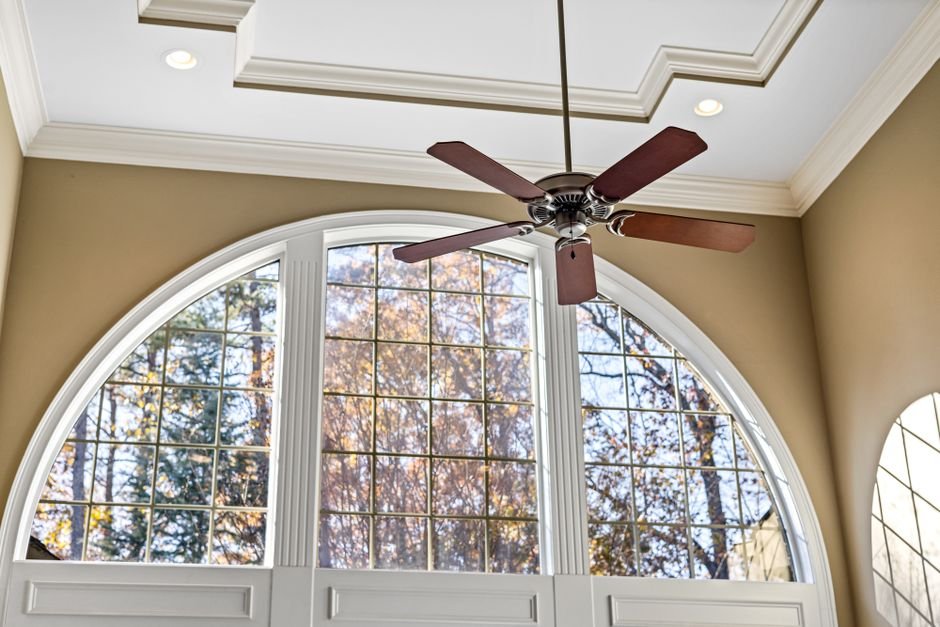
The shape, size, pitch, and material of the fan blades are critical to their ability to generate and direct airflow. High-speed ceiling fans often feature aerodynamically optimized blades designed to minimize drag and maximize lift.
-
Blade Pitch: This refers to the angle at which the blades are set relative to the horizontal plane. A steeper blade pitch generally moves more air but requires a more powerful motor. High-speed fans often utilize a pitch between 12 and 15 degrees, striking a balance between air movement and motor strain. The angle of the blades acts like an airfoil on an airplane wing. As the blade moves through the air, the air flowing over the curved upper surface travels a slightly longer distance than the air flowing beneath the flatter lower surface. This creates a pressure difference, with lower pressure above the blade and higher pressure below. This pressure differential generates a downward force, pushing air towards the room.
-
Blade Shape and Size: Wider and longer blades can sweep a larger volume of air with each rotation. However, excessively large or heavy blades can increase drag and put undue stress on the motor. High-speed fans often employ a combination of optimized width and length, ensuring efficient air displacement without compromising motor longevity. The shape also plays a role in directing the airflow. Some blades are designed with a slight curve or wingtip to reduce air turbulence at the edges, allowing for smoother, more consistent airflow.
-
Blade Material: While traditional fans might use wood or plastic, high-speed models often benefit from lighter yet stronger materials like reinforced polymers, aluminum, or even carbon fiber. These materials reduce the rotational inertia of the blades, allowing them to accelerate and decelerate more quickly, contributing to higher speeds and responsiveness. Lighter blades also place less demand on the motor, enabling it to achieve and maintain higher RPMs.
Motor Power and Efficiency: The Driving Force
The motor is the heart of any ceiling fan, and for high-speed operation, a robust and efficient motor is paramount.
-
Horsepower and Torque: Higher horsepower motors provide the necessary torque to spin the blades at greater speeds, especially under load (i.e., when moving a significant volume of air). The torque is the rotational force applied by the motor. For high-speed fans, a motor with sufficient torque is essential to overcome the resistance of the air and maintain a consistent high RPM.
-
Motor Type: Direct-drive motors are common in many ceiling fans, where the blades are directly attached to the motor shaft. Brushless DC (BLDC) motors are increasingly being adopted in high-end models. BLDC motors are significantly more energy-efficient, quieter, and offer greater control over speed and direction. They achieve this by using electronic commutation instead of mechanical brushes, reducing friction and energy loss. This efficiency allows them to deliver higher airflow with lower power consumption.
-
Energy Consumption: While high-speed fans naturally consume more power than their slower counterparts, advancements in motor technology have led to significant improvements in energy efficiency. Comparing the CFM (Cubic Feet per Minute) to wattage ratio is a key metric. A higher CFM/watt indicates a more efficient fan. High-speed fans, when well-designed, can offer a superior cooling effect for the energy consumed compared to less efficient, lower-speed models.
Rotational Speed (RPM) and Airflow (CFM): The Direct Measure of Performance
The most direct indicators of a fan’s air-moving capability are its rotational speed, measured in revolutions per minute (RPM), and its airflow, measured in cubic feet per minute (CFM).
-
RPM: High-speed ceiling fans typically operate at RPMs significantly higher than standard fans. This increased speed directly translates to more air being moved. However, simply increasing RPM without considering blade design can lead to increased noise and air turbulence.
-
CFM: This is the ultimate measure of a fan’s effectiveness in circulating air. A higher CFM rating means the fan moves more air. High-speed fans are designed to achieve high CFM ratings through the synergistic effect of their blade design, motor power, and optimized RPM. When comparing fans, the CFM rating should be a primary consideration, especially for larger rooms or areas where enhanced air circulation is desired. It’s also important to note that CFM ratings are often measured at the maximum speed setting.
Beyond Basic Functionality: Advanced Features and Scientific Considerations
Modern high-speed ceiling fans often incorporate advanced features that further enhance their performance and user experience, all rooted in scientific principles.
-
Reverse Functionality: The ability to reverse the direction of the fan blades (clockwise for winter, counter-clockwise for summer) is a scientifically sound feature. In summer, the counter-clockwise rotation pushes cool air downwards, creating the wind chill effect. In winter, clockwise rotation at a low speed gently pulls cooler air from the floor upwards, circulating warmer air trapped near the ceiling without creating a draft. This is achieved by simply altering the motor’s direction of rotation.
-
Smart Technology and Sensors: Integration with smart home systems and the use of sensors for temperature and humidity allow for intelligent fan operation. These systems can automatically adjust fan speed based on ambient conditions, optimizing comfort and energy usage. For instance, a temperature sensor can detect a rise in room temperature and automatically increase the fan speed, while a humidity sensor can signal the fan to maintain a certain airflow to reduce the feeling of mugginess.
-
Noise Reduction: High-speed operation can sometimes be associated with increased noise. However, scientific advancements in blade design, motor balancing, and bearing technology have led to remarkably quiet high-speed fans. Aerodynamic blade shapes that minimize air turbulence and precisely balanced motors contribute to a quieter operation. The use of specialized bearings, such as ball bearings, also reduces friction and noise.
-
Air Movement Patterns: While many fans create a general downward downdraft, some high-speed models can be designed to create more targeted or diffused airflow patterns, depending on the application. This can be achieved through specific blade contours and housing designs, influencing how the air is dispersed throughout the room.
In conclusion, the science behind high-speed ceiling fans is a fascinating interplay of aerodynamics, motor engineering, and fluid dynamics. By optimizing blade pitch, shape, and material, employing powerful and efficient motors, and achieving higher rotational speeds, these fans are engineered to maximize air circulation, providing superior cooling comfort and enhancing the overall ambiance of any space. Their continued evolution, driven by scientific innovation, promises even greater performance and efficiency in the future.