
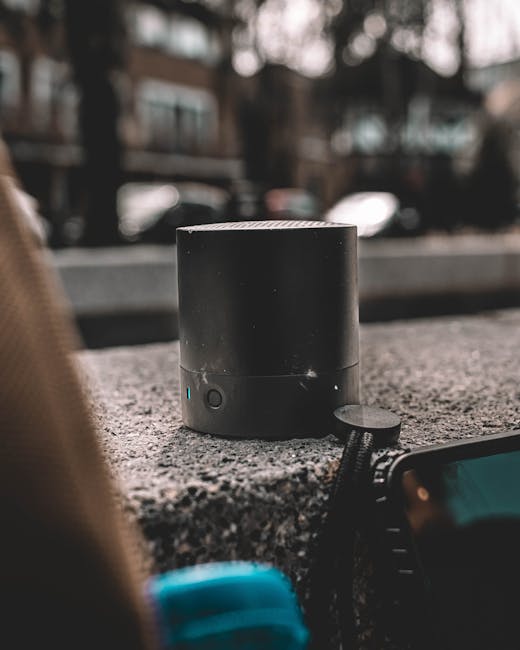
Unleashing the Rumble: Bluetooth Speakers with Unrivaled Deep Bass Performance
For audiophiles and bass enthusiasts alike, the quest for a Bluetooth speaker that delivers truly profound and resonant low frequencies can be a challenging one. While many portable speakers offer a pleasant listening experience, achieving that visceral, room-filling bass often requires a significant investment and careful consideration of specific acoustic principles. This article delves into the world of Bluetooth speakers engineered for unrivaled deep bass performance, exploring the technologies, design choices, and key features that contribute to their earth-shaking capabilities.
The foundation of exceptional deep bass lies in the driver size and excursion. Larger drivers, typically 4 inches and above, possess a greater surface area to move more air. This is crucial for reproducing the lower end of the frequency spectrum, which requires substantial air displacement. However, size alone isn’t the sole determinant. Excursion, the distance a speaker cone can travel back and forth, plays an equally vital role. Drivers with high excursion capabilities can push and pull more air with each oscillation, translating directly into a more powerful and impactful bass response. Look for specifications that mention large diameter drivers and a focus on excursion capabilities.
Beyond driver size, passive radiators have become a cornerstone of modern deep bass Bluetooth speaker design. Unlike traditional ported enclosures that rely on a port to release bass frequencies, passive radiators are essentially unpowered speaker cones. They work in tandem with the active driver, vibrating in response to the air pressure changes within the enclosure. This symbiotic relationship allows for significantly more bass output from a smaller, more compact form factor. The absence of port noise, which can sometimes plague ported designs, is another significant advantage of passive radiators, contributing to a cleaner and more defined low-end. Brands renowned for their bass prowess often feature prominent passive radiators on their speakers, a visual cue to their low-frequency ambitions.
The enclosure design and material are also critical. A rigid and well-braced enclosure minimizes unwanted vibrations and resonances that can muddy the bass. Materials like high-density plastics, aluminum, or even wood composites are often employed. Internal bracing within the enclosure further reinforces its structure, preventing it from flexing under the pressure of powerful bass waves. The internal volume of the enclosure also plays a role, providing adequate space for the drivers to breathe and perform optimally. Some manufacturers dedicate significant engineering effort to acoustic modeling and simulation to optimize enclosure dimensions for maximum bass response.
Digital Signal Processing (DSP) has revolutionized the capabilities of modern Bluetooth speakers, and it’s particularly instrumental in enhancing deep bass. Sophisticated DSP algorithms can intelligently equalize the audio signal, boosting specific low-frequency ranges without causing distortion or overpowering other elements of the music. They can also manage power delivery to the drivers, preventing them from being overdriven and ensuring a clean and controlled bass response even at high volumes. Advanced DSP can even adapt to the speaker’s environment, optimizing bass output for different room acoustics. Features like “Bass Boost” or dedicated bass modes are often implemented through DSP.
Amplification power is another non-negotiable factor. To drive larger drivers and passive radiators effectively, a powerful amplifier is required. Look for speakers with substantial wattage ratings, particularly for the low-frequency drivers. While wattage figures can sometimes be misleading, a higher number generally indicates a greater ability to deliver clean power to the speakers, resulting in a more dynamic and impactful bass. Consider the RMS (Root Mean Square) wattage for a more realistic representation of sustained power output.
Bluetooth codecs can subtly influence bass performance, although their impact is often less pronounced than the physical design elements. While most common codecs like SBC and AAC are sufficient for general listening, higher-fidelity codecs like aptX HD or LDAC can transmit more audio data, potentially preserving more of the nuance and detail in the bass frequencies. For the absolute purest bass experience, a wired connection might still offer a slight edge, but the convenience of Bluetooth is undeniable.
When evaluating Bluetooth speakers for deep bass, pay attention to frequency response specifications. While a speaker might claim a wide frequency range, focus on the lower end. A speaker that reaches down to 40Hz or even lower with minimal roll-off will undoubtedly provide a more profound bass experience than one that starts its response at 80Hz. Look for graphs that illustrate the frequency response and note the decibel (dB) level at different frequencies.
Stereo pairing capabilities can also amplify the bass experience. When two identical speakers are paired in stereo, they can effectively double the bass output and create a more immersive soundstage. This is because each speaker can dedicate more power and resources to reproducing specific frequency ranges, leading to a richer and more impactful low-end.
Portability vs. Bass Prowess: It’s important to acknowledge the inherent trade-offs. Achieving truly unrivaled deep bass often requires larger drivers, more robust enclosures, and more powerful amplification, which inevitably leads to larger and heavier speakers. While manufacturers are constantly innovating to miniaturize these components, there’s a limit to how much bass can be extracted from a pocket-sized device. For the ultimate deep bass experience, you’ll likely be looking at portable speakers that are still substantial in size and weight.
Brands to Watch: Several manufacturers have built their reputation on delivering exceptional bass performance. Companies like JBL with their Charge and Xtreme series, Sony with their SRS-XG series, UE (Ultimate Ears) with their MEGABOOM and HYPERBOOM lines, and Bose with their Bass Module accessories for SoundLink speakers are consistently recognized for their low-frequency capabilities. Researching specific models within these brands that are explicitly marketed for their bass output is a wise strategy.
Listening Tests are Crucial: While specifications and reviews provide valuable insights, nothing beats a personal listening test. When auditioning speakers, play music with prominent basslines, such as electronic dance music, hip-hop, or certain rock genres. Pay attention to the clarity, depth, and impact of the bass. Does it feel tight and controlled, or boomy and muddy? Does it extend low enough to be felt as well as heard? Does it overpower the mid-range and treble, or is it well-balanced?
Ultimately, selecting a Bluetooth speaker with unrivaled deep bass performance is a journey of understanding the underlying acoustic principles and recognizing the engineering feats that enable such sonic power. By focusing on driver technology, enclosure design, DSP, and amplification, you can navigate the market and find a speaker that truly unleashes the rumble.